Author name: admin

Blog

Shocking Stories of Wage Theft in California: Protect Your Rights by Joining WRCA

Posted on September 13, 2025, by Workers Rights Compliance Alliance (WRCA)

In the bustling economy of California, where industries like hospitality, construction, and fast food thrive, wage theft remains a persistent and devastating issue. Thousands of workers—often from vulnerable communities—face unpaid wages, denied breaks, and misclassification that strips them of rightful earnings and protections. At the Workers Rights Compliance Alliance (WRCA), we’re dedicated to shining a light on these injustices and empowering workers and employers alike to ensure compliance with labor laws. By joining our organization today at workersrightscompliancealliance.com, you’ll stay informed on the latest developments, receive expert guidance, and become part of a community fighting for fair workplaces. Don’t miss out—join WRCA now to get updates on workers’ rights and compliance strategies straight to your inbox!

In this blog post, we’ll dive into real stories from 2025 that highlight the human cost of wage violations. These cases, drawn from official enforcement actions by the California Labor Commissioner’s Office (LCO), underscore why staying vigilant is crucial. As a member of WRCA, you’ll have access to resources like webinars, compliance checklists, and alerts on emerging trends, helping you navigate these challenges effectively.

1. The Koreatown Restaurant Saga: Overworked and Underpaid at J BBQ

Imagine clocking in for a grueling shift at a popular Koreatown eatery, only to be denied basic breaks and forced into split shifts without extra pay. This was the reality for 48 workers at J BBQ, operated by Midri, Inc. and owner Byung Kwan Lee. On September 4, 2025, the LCO issued citations totaling over $680,000 for wage theft, including unpaid wages, denied meal and rest breaks, and inaccurate wage statements. Workers were often kept on-site during “lunch” to handle customers, violating California labor laws designed to protect their well-being.

The breakdown? $538,638 goes directly back to the workers, a hard-won victory referred by the Koreatown Immigrant Workers Alliance. Labor Commissioner Lilia García-Brower emphasized the risks restaurant workers face, stating, “These citations reflect our continued efforts to hold employers accountable.” Stories like this reveal how wage theft erodes trust and livelihoods, leading to financial strain and health issues for employees.

At WRCA, we believe knowledge is power. By joining our organization, you’ll receive timely updates on similar cases, plus tools to audit your own workplace or business for compliance. Sign up now at workersrightscompliancealliance.com and be the first to know about new enforcement actions—empowering you to advocate for change.

2. A Multimillion-Dollar Verdict: Justice for Two Brave Workers in San Francisco

On September 5, 2025, a San Francisco jury delivered a resounding $8.5 million verdict in favor of plaintiffs Marianne Ramirez and Wendy (last name withheld) in a wage-and-hour lawsuit. The case, presided over by Judge Andrew Y. S. Cheng, stemmed from violations dating back to May 2024, including unpaid overtime, denied meal and rest breaks, inaccurate wage statements, waiting time penalties, and potential employee misclassification.

The jury’s decision highlighted skepticism toward the employer’s defenses and a desire to deter future wrongdoing. While specific employer details remain private, this verdict sends a clear message: workers can fight back and win. For the plaintiffs, it meant reclaiming lost earnings amid rising living costs, but for many others, such battles are daunting without support.

That’s where WRCA comes in. As a member, you’ll gain access to legal resources, case studies, and networking opportunities to stay ahead of wage disputes. Join our growing alliance today at workersrightscompliancealliance.com and ensure you’re always updated on landmark rulings that could impact your rights or business.

3. Construction Site Schemes: $2.3 Million in Citations for L.A. Developers

In August 2025, the LCO targeted a web of Los Angeles developers and entities with over $2.3 million in citations for wage theft at four construction sites, affecting 124 workers from May 2021 to August 2023. Violations included skipping overtime pay despite exhausting hours, paying below the local minimum wage, denying sick leave (even during the pandemic), and issuing misleading wage statements. The scheme used multiple entities to dodge rules, with workers reporting to the same bosses across sites.

Affected employees—framing, tiling, painting, and plumbing—were owed $2.1 million in unpaid wages and damages, plus $165,000 in interest, averaging $18,900 per person. Key parties: Todd Wexman, Bridget Wexman, Jeffrey Farrington, and companies like San Fernando Studios LP/LLC. García-Brower called out these “corporate shell games.” This case exposes how construction’s high-risk environment compounds with wage issues, leaving workers vulnerable to exploitation.

WRCA is your ally in combating such practices. By joining us at workersrightscompliancealliance.com, you’ll get exclusive insights into industry-specific compliance, training sessions, and alerts on BOFE investigations—keeping you informed and protected.

4. Hospitality’s Hidden Exploitation: Ritz-Carlton and Subcontractors Fined $2 Million

July 2025 brought scrutiny to the Ritz-Carlton Half Moon Bay, where the LCO cited the hotel and three out-of-state janitorial subcontractors for misclassifying 155 janitors as independent contractors from July 2021 to January 2024. This denied them minimum wage, overtime, sick leave, and workers’ compensation—core protections under California law.

Citations totaled $1.9 million payable to workers, with joint liability if subcontractors default. Referred by the San Mateo County DA after a worker’s tip to nonprofit Coastside Hope, it highlights subcontracting pitfalls. Janitors, often working invisibly, faced grueling conditions without fair pay, amplifying inequality in luxury hospitality.

Stay ahead with WRCA’s expert resources. Join our organization now at workersrightscompliancealliance.com for updates on misclassification risks and how to ensure compliance in your sector.

5. Fast Food’s Rising Crisis: A Study on Systemic Wage Theft

A February 2025 study from Northwestern and Rutgers Universities revealed that 25% of Greater L.A. fast food workers were paid below minimum wage in 2024—up dramatically from 3% in 2009. This costs workers $44 million yearly, with average losses of $3,479 per person. Tied to wage hikes (up to $20/hour in 2025 for fast food), violations include underpayment, denied breaks, and retaliation fears among immigrant and youth workers.

The report warns of skipped meals and evictions for victims, calling for stronger enforcement amid low unionization. As 2025 unfolds, similar patterns persist, affecting service industries statewide.

At WRCA, we’re committed to education and advocacy. By joining us at workersrightscompliancealliance.com, you’ll receive reports like this, plus actionable advice to prevent or address wage theft—ensuring a fairer future for all.

Why Join WRCA Today?

These stories aren’t isolated—they’re part of a statewide epidemic where nearly 19,000 claims alleged $338 million in stolen wages last year. With delays in enforcement and proposed reforms in June 2025 aiming to boost accountability, staying informed is key. WRCA offers newsletters, workshops, and a network of experts to keep you updated on workers’ rights compliance.

Don’t wait for the next violation to hit close to home. Join the Workers Rights Compliance Alliance today at workersrightscompliancealliance.com and be part of the solution. Together, we can build compliant, equitable workplaces.

Follow us on social media for more stories and tips. #WorkersRights #WageTheft #JoinWRCA

Blog

The Legacy of Charlie Kirk: A Look Back at His Activism

The Legacy of Charlie Kirk: A Look Back at His Activism

Charlie Kirk co-founded Turning Point USA in 2012, aiming to promote conservative values among young people on college campuses. Under his leadership, the organization grew significantly, hosting events and training students to engage in political activism. Kirk’s approach was often confrontational, challenging liberal viewpoints and advocating for limited government and free markets. His death has prompted reflections on his impact on conservative youth culture and the broader political landscape. ([whyy.org](https://whyy.org/articles/charlie-kirk-shot-utah-college/?utm_source=openai))

charlie kirkturning point usaconservative activismus politicsyouth engagement

Meta: A retrospective on Charlie Kirk’s activism and his influence on conservative youth culture through Turning Point USA.Copy TitleCopy ContentCopy Tags

Investigating the Shooting of Charlie Kirk: Law Enforcement’s Response

In the aftermath of Charlie Kirk’s assassination, law enforcement agencies have launched an extensive investigation to apprehend the perpetrator. The FBI, in collaboration with local authorities, is reviewing surveillance footage and conducting interviews with witnesses to gather information. A person of interest has been identified, and authorities are appealing to the public for any information that could lead to an arrest. The investigation is ongoing, with officials emphasizing the importance of community cooperation in resolving this case. ([ksl.com](https://www.ksl.com/article/51373713?utm_source=openai))

charlie kirkshooting investigationlaw enforcementfbiutah valley university

Meta: Details on the ongoing law enforcement investigation into the shooting of Charlie Kirk, including efforts by the FBI and local authorities.Copy TitleCopy ContentCopy Tags

The Impact of Charlie Kirk’s Death on Political Discourse

The death of Charlie Kirk has sparked a nationwide conversation about the state of political discourse in the United States. As the founder of Turning Point USA, Kirk was known for his provocative style and confrontational approach to political debates. His assassination raises questions about the safety of political events and the potential consequences of increasingly polarized rhetoric. Analysts suggest that this tragedy may serve as a catalyst for a broader discussion on civility and the need for respectful dialogue in political arenas. ([time.com](https://time.com/7316095/charlie-kirk-uvu-shooting-turning-point-usa/?utm_source=openai))

charlie kirkpolitical discourseus politicsturning point usapolitical violence

Meta: An analysis of how Charlie Kirk’s death has influenced discussions on political discourse and the need for respectful dialogue in the US.Copy TitleCopy ContentCopy Tags

Political Reactions to the Assassination of Charlie Kirk

The assassination of Charlie Kirk has elicited strong reactions from political leaders across the spectrum. Former President Donald Trump described Kirk as a “martyr for truth and freedom,” attributing the violence to the rhetoric of the “radical left.” Democratic leaders also condemned the act; California Governor Gavin Newsom called it “disgusting, vile, and reprehensible,” emphasizing the need to reject political violence in all forms. Former President Barack Obama stated that such “despicable violence has no place in our democracy.” These statements highlight the bipartisan concern over the escalation of political violence in the United States. ([abc7.com](https://abc7.com/post/charlie-kirk-shot-during-event-utah-university-jd-vance-says-say-prayer/17787449/?utm_source=openai))

political reactionscharlie kirkpolitical violencebipartisan condemnationus politics

Meta: An overview of the bipartisan political reactions to the assassination of Charlie Kirk, highlighting statements from leaders across the political spectrum.Copy TitleCopy ContentCopy Tags

The Tragic Shooting of Charlie Kirk at Utah Valley University

On September 10, 2025, Charlie Kirk, the 31-year-old conservative activist and founder of Turning Point USA, was fatally shot during an event at Utah Valley University (UVU). The incident occurred in the Sorensen Center courtyard, where Kirk was addressing an audience of approximately 3,000 people. Witnesses reported that Kirk was speaking into a handheld microphone when a single gunshot rang out, striking him in the neck. The shooter, described as wearing dark clothing, fired from a rooftop some distance away. Kirk was immediately rushed to a nearby hospital but was pronounced dead shortly after arrival. ([whyy.org](https://whyy.org/articles/charlie-kirk-shot-utah-college/?utm_source=openai))

charlie kirkutah valley universityshooting incidentturning point usapolitical violence

Meta: A detailed account of the tragic shooting of Charlie Kirk at Utah Valley University, including witness reports and the immediate aftermath.Copy TitleCopy ContentCopy Tags

Generated Posts for: Charlie Kirk, a voice for young conservatives, dies at age 31

The Legacy of Charlie Kirk: A Young Conservative’s Impact

At the age of 31, Charlie Kirk’s untimely passing has left a void in the conservative movement. His contributions, particularly in mobilizing young conservatives, have had a lasting impact. Through Turning Point USA, Kirk inspired countless students to engage in political activism and to advocate for conservative principles. His leadership and vision have set a precedent for future generations of conservatives, emphasizing the importance of youth involvement in politics. Kirk’s legacy continues to influence the direction of conservative thought and activism in America.

charlie kirkconservative legacyyouth activism

Meta: Reflect on Charlie Kirk’s lasting impact on the conservative movement and youth activism.Copy TitleCopy ContentCopy Tags

Charlie Kirk’s Influence on Conservative Media and Politics

Beyond his work with Turning Point USA, Charlie Kirk has significantly influenced conservative media and politics. He is the host of “The Charlie Kirk Show,” a daily podcast and radio program that discusses current events from a conservative perspective. The show has garnered a substantial following, reflecting Kirk’s ability to articulate and promote conservative viewpoints effectively. Additionally, Kirk has been a frequent guest on various news networks, providing commentary on political developments and policy issues. His presence in media has solidified his status as a leading voice in conservative circles.

charlie kirkconservative mediapolitical commentary

Meta: Learn about Charlie Kirk’s impact on conservative media through his podcast and media appearances.Copy TitleCopy ContentCopy Tags

Turning Point USA: The Organization Behind Charlie Kirk’s Vision

Founded by Charlie Kirk in 2012, Turning Point USA (TPUSA) has become a pivotal organization in American conservative politics. Its mission is to educate and organize students to promote the principles of free markets and limited government. TPUSA’s influence is evident through its extensive network of campus chapters, which serve as hubs for conservative thought and activism. The organization’s events, such as the annual Student Action Summit, draw thousands of young conservatives eager to engage with like-minded peers and influential speakers. Through these initiatives, TPUSA has played a crucial role in shaping the political landscape for a new generation.

turning point usacharlie kirkconservative politics

Meta: Discover the impact of Turning Point USA, founded by Charlie Kirk, in shaping conservative politics among students.Copy TitleCopy ContentCopy Tags

The Rise of Charlie Kirk: From College Activist to Conservative Leader

Charlie Kirk’s journey from a college student to a prominent conservative figure is a testament to his dedication and strategic acumen. In 2012, at the age of 18, Kirk founded Turning Point USA, an organization aimed at promoting conservative values among young people. His vision was clear: to create a platform that would empower students to engage in political discourse and activism. Under his leadership, Turning Point USA expanded rapidly, establishing chapters in numerous colleges and universities across the nation. Kirk’s ability to connect with young conservatives and his commitment to his cause made him a significant voice in American politics.

charlie kirkturning point usaconservative leader

Meta: Explore Charlie Kirk’s journey from college activist to leading conservative figure and founder of Turning Point USA.

Blog

Striking Boeing Workers Say No To Contract Offer

Boeing workers in St. Louis have rejected a tentative deal. CNBC reports: “Striking Boeing defense workers in Missouri voted Friday against the company’s latest offer of a modified contract deal, according to the union representing the workers. More than 3,000 workers in the St. Louis area will remain on strike, the first walkout in almost…

Source

Blog

Why HR Might Be the Hardest Job in the C-Suite

Recently, while recording a podcast, I found myself talking about something I’ve been thinking about for a long time: how much harder HR is than people give it credit for.

We tend to see HR as “soft” compared to the other seats in the C-suite. CFOs, COOs, and CTOs have hard numbers and clear metrics. They work in a world where things are either right or wrong. But HR? HR lives in the gray.

And I’ve come to believe this: HR is more art than science.
That’s exactly what makes it so hard—and so undervalued.  This week’s Friday’s Five, explains why HR is so difficult (and undervalued):

1. HR Operates in the Messy Human World

Accounting and finance are governed by rules and logic. HR deals with human beings, which means emotions, personalities, conflicts, potential, and fear. There’s no formula for managing people. What worked brilliantly with one person may fail with another. It’s more like painting or composing music than solving math equations.

2. Hiring Is One of the Hardest—and Riskiest—Skills

It is widely known that highly experienced leaders are only about 50/50 when it comes to making successful hires. Why? Because interviews are theater. Candidates put forward their best selves, and your job is to see through the performance and predict how they will act under real pressure, on real teams, over real time.

That’s not a science. That’s pattern recognition, intuition, and sometimes luck—the hallmarks of art.

3. HR’s Wins Are Invisible

When HR does its job well, nothing dramatic happens. Culture is stable. People work well together. Turnover stays low. But these wins rarely show up on spreadsheets. Unlike revenue or expenses, you can’t point to a single line item that says “HR succeeded.”

HR’s impact is critical on an organization, but often invisible until it’s gone.

4. Finding the “Obvious” Is an Art

In Obvious Adams by Robert R. Updegraff, Adams becomes legendary not because he’s more analytical than everyone else, but because he sees what others overlook.

As he explains:

“Picking out the obvious thing pre-supposes analysis, and analysis pre-supposes thinking… They don’t gather all the facts and then analyze them before deciding what really is the obvious thing.”

And:

“I never stopped to think in those days whether a thing was obvious or not. I just did what occurred to me naturally after I had thought things over.”

That’s what makes it art.

It looks simple only after he says it — but seeing it requires a cultivated instinct. HR works the same way. The best people decisions rarely come from spreadsheets. They come from the hard, quiet work of observing patterns, understanding human behavior, and having the courage to trust your judgment.

5. HR Shapes the System Everyone Else Operates In

Every other C-suite role relies on having the right people in the right seats. HR creates that system. They build the culture that makes execution possible. They influence the trajectory of every hire, every promotion, every leader.

And yet—because their work is hard to quantify—they often don’t get the credit. They are judged on lagging indicators, which are often not valued until they are missing from the organization.

The Takeaway

We undervalue HR because we expect it to behave like a science, when it’s actually an art.And art is harder.

If you lead in HR—or support those who do—remember: you’re doing one of the hardest jobs in business. Just because it’s hard to measure doesn’t mean it’s not the most important.

And if you want a quick, powerful reminder of how to see the truths others miss, I highly recommend reading Obvious Adams — it’s one of the best short business books I’ve ever read, and I think every business executive should read it.

The post Why HR Might Be the Hardest Job in the C-Suite appeared first on California Employment Law Report.

Blog

Boeing And Union Reach Tentative Deal To End St. Louis Strike

A major strike has come to an end after a tentative deal was reached. NPR reports: “The local machinists union has reached a tentative agreement with Boeing St. Louis. Members of IAM District 837 have been on strike for over a month after rejecting two contracts from the company. The five-year tentative agreement includes a…

Source

Blog

Union Membership Decreased By 200,000 In ‘Right-To-Work’ States In 2024

Union membership in so-called “right-to-work” states saw significant declines in 2024. The Guardian reports: “Add another growing split to the increasingly divided United States: union membership. US states that protect unions’ collective bargaining rights have experienced an increase in new union members, while states with anti-union ‘right to work’ laws are responsible for declines in…

Source

Blog

Understanding the Regular Rate of Pay

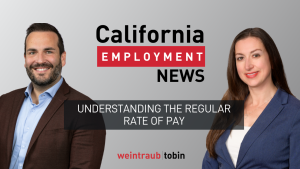
In this episode of California Employment News, Weintraub attorneys Ryan Abernethy and Talia Delanoy revisit the complexities of the regular rate of pay—a frequent issue in wage and hour class actions. From bonuses and shift differentials to common employer mistakes, they break down what must (and must not) be included in calculations, and the costly risks of getting it wrong.

Watch this episode on the Weintraub YouTube channel.

Show Notes:

Ryan: Hello, everyone, and thank you for joining us for this installment of California Employment News, an informative video and podcast resource offered by the Labor and Employment Group here at Weintraub Tobin. My name is Ryan Abernethy, and I’m a shareholder in the firm’s Labor and Employment Group. I’m joined today by my partner, Talia Delanoy, who is new to our group, and this is her inaugural episode.

We’re happy to have her join our team here. Over three years ago now, Lukas Clary and I spoke with you about the regular rate of pay. But since the regular rate of pay is such a prevalent issue that is increasingly featured in Wage and Hour class actions that we’re seeing pouring in. We wanted to revisit that topic today.

Talia, why don’t you start us off by giving us a refresher with some basic information about the regular rate of pay, what it is exactly, and what needs to be included within it.

Talia: Yes, absolutely. Thank you, Ryan. Most employers assume that the base rate of pay and employees regular hourly rate is all they need to think about when they calculate overtime and double-time. They just take the base rate of pay, multiply it by one and a half for overtime or two for double time, and that’s it. Unfortunately, the calculation isn’t that simple. The regular rate of pay, which is different from the base rate of pay, actually includes additional income such as non-discretionary bonuses, shift differentials, which is like additional pay when you have an employee use an undesirable schedule or for a weekend or overnight work, piece rate compensation, such as payment per box of fruit picked, or even commissions. Employers need to add to have all of these types of income in addition to the employee’s base hourly rate before calculating both overtime, double time, sick pay, and meal and rest period premium payments. To make this even more complicated, the law requires one calculation for a flat sum bonus, such as $50 paid for weekend work, and another calculation for production bonuses, such as an employee who might earn 5% of all sales in a given month.

Talia: Let’s Let me give you a quick example. If you’re paying an employee a flat-sum bonus, here’s the example. Your employee earns $16 per hour and works 40 straight-time hours and four overtime hours on Saturday. The straight The overtime payment is simple. $16 times 40 hours equals $640. The overtime payment, $24 an hour times 4 hours equals $96. Now, the employee has paid the $50 bonus for working on Saturday. Now you need to calculate the overtime compensation due on the bonus. Now this is where the math comes in. You take $50 in bonus, you divide it by the 40 hours of straight time hours worked, and this gets you $1. 25, which is the per hour value of the bonus. Now you take that $1. 25, you multiply it by 1. 5 for the overtime, and you get $1 87. 5. This is the bonus overtime value per hour. Now you have to actually figure out how much of that goes to the overtime. You take the $1. 87. 5 times the 4 hours of overtime the employee worked, and you get $7. 50. This is the overtime due on the bonus. This is the part that most employers miss.

Talia: When you add all of that up, the total straight time pay, the total overtime pay, the $50 flat sum bonus, and that $7. 50 over time owed on the bonus, you get a total of $793. 50.

Ryan: Well, thank you, Talia. How about some good news now that we realize that a lot of us out there might be underpaying our employees based on the regular rate? Let’s discuss what doesn’t need to be included in the regular rate. There are at least three categories of items that can be excluded from the regular rate calculation because they’re not considered wages. The first exclusion is for payments that could be categorized as gifts or gratuities. This would include employer contributions to retirement life or other insurance benefits. Benefits. It also includes holiday bonuses or other payments given to employees that are considered rewards for service or rewards for loyalty, so long as the amounts paid are not directly measured by the employee’s hours worked or the employee’s production or efficiency. The second category of item that can be excluded from the regular rate includes items and payments that are made for periods where no work is performed. This is stuff like vacation pay, paid sick sick pay or similar payments. The third category is expense reimbursements, which are obviously not considered wages. Now, this shouldn’t be confused with per diem payments, which usually are required to be included in the regular rate of pay calculations.

In addition, the cost or the value of loggings or meals that the company provides to employees often must be included as well in the regular rate of pay under certain circumstances. It’s pretty detailed, so we won’t get into that today, but just be aware of that. It’s also important to remember that premium payments must be paid at the regular rate of pay, not the base hourly rate. Just a refresher, under California law, not exempt employees who are not providing compliant meal or rest breaks are entitled to an extra hour of pay under the labor code. This payment is called a premium. We discuss this premium in more detail in other episodes. But many employers pay these premiums out at the employer’s base hourly rate, and that’s a mistake because the California Supreme Court has clarified that premiums must actually be paid at the often higher regular rate of pay. That would be a violation just by getting that wrong. Sick leave must also be paid out the regular rate of pay and not the base hourly rate. Talia, why don’t you share with us some of the risks employers face for getting the regular rate wrong?

Talia: Absolutely, yeah. Unfortunately, regular rate of pay violations are low hanging fruit. An attorney need only request the employee’s payroll records, which the employers are obligated to provide, and they do some simple math to see if there are violations. If an employee’s pay stub shows an overtime rate that is exactly one and a half times the base rate of pay in the same pay period that the employee earned a bonus or other income like we discussed earlier, then that lawyer knows they have a slam dunk case. In the example that I gave earlier, if an employer neglected If you wanted to include that Saturday work bonus in the overtime calculation, that $7. 50 omission could cost the employer thousands of dollars. This is made up of significant penalties, $100 per employee per pay pay period and up to 30 days of pay at the employee’s full daily rate if the error is discovered after the employee quits or is terminated. The damages also include interest, potential liquidated damages, and payment of the employee’s attorney’s fees. This is a huge sum of money for missing a payment of just $7. 50. Employers, unfortunately, can also be subject to class action liability if they fail to use the regular rate of pay for all of their employees.

Talia: In this very scary turn, those damages can extend back four years from when an employee files a lawsuit.

Ryan: Thank you, Talia. We know this is a scary topic for some, and it’s pretty complicated. You can always reach out to one of our attorneys here at Weintraub if you have any specific questions about the regular rate or how to calculate production bonuses. With that, that’ll do it for today. We thank you all for joining us. You can continue to find California Employment News at our blog at www.thelelawblog.com and wherever you listen to your favorite podcasts. With that, we’ll see you next time. Thank you for joining us.

Talia: Thank you.

Blog

So You’ve Received a PAGA Letter, Now What? Attend Our Webinar to Find Out Your Next Steps

Before someone can file an action under PAGA (Private Attorneys General Act), they have to file a letter with the LWDA and set forth what they think the employer did wrong. The LWDA has 60-days to review the letter and decide whether to investigate the issues. If the LWDA does not take action (and they rarely, if ever, do), then a PAGA complaint can be filed 65 days after the letter was first submitted to the LWDA.

Under PAGA reform, that PAGA letter triggers a 60-day review period, where employers can audit their practices and take steps to fix issues. If they do so proactively, and retain evidence of the audit and its results, available PAGA penalties can be discounted as much as 70% (or 85% if they audit before getting a PAGA letter). Given that PAGA penalties accumulate per employee at the rate of at least $100 per pay period with a violation, that means taking quick action can save thousands of dollars.

That’s why I am speaking about what to do upon receipt of a PAGA letter at my firm’s upcoming webinar on Employment Class & Collective Actions: Strategies for Defense and Compliance on September 30, 2025. The webinar starts at 9 am PT, and my session will be at 11 am PT.

Other topics covered at the webinar will be:

  • Preventing systemic discrimination class actions caused by AI.
  • Navigating worker misclassification issues.
  • Preparing for the EEOC’s focus on systemic religious discrimination.

Other featured speakers include: Nikki H. HowellSteven W. Moore, and Renee J. Sheyko.

You may sign up for this webinar here.

Start being proactive today! Sign up and be ready when that LWDA letter hits your inbox.

Blog

Thank You All For A Great Union Night At Dodger Stadium

Thousands of union brothers and sisters got together on August 30 for Labor 411’s Union Night at Dodger Stadium. The event is an annual tradition celebrating the Los Angeles labor community in a fun setting of baseball and camaraderie. Los Angeles County Firefighters, IAFF Local 1014 President Dave Gillotte provided the honor of throwing the…

Source

Scroll to Top